A SHORT INTRODUCTION (A THEORETIC DESCRIPTION)
This Introduction is not scientific or medical, it´s
a description in words everybody should understand, as we don´t suggest
that it´s the only conclusion or the last knowledge in the area of
psychologic disorders!
First we want to do some definitions:
We in this definition divide consiousness into two parts,
the known part and the unknown (unconsious) part, that some psychologists
call unconsiousness or the part You don´t have willing or influence
on.
Also we define mind as a machine that deals with a special
workload (all we imagine as mental jobs).
Now we will describe it further:
In many psychologic or psychiatric disorders the main
problem is the overload of mind with too much workload (consious or unconsious),
that causes stress and at least nervous breakdowns, like the motor of a
car that runs on too much speed, producing high temperature and at least
without cooling stops work.
Psychiatry tries to cool down Your "motor" (mind) through
sedating medication, psychology wants You to reduce the workload through
learning, understanding and coping, as far as change the way You deal with
Your workload and behave in overwhelming situations.
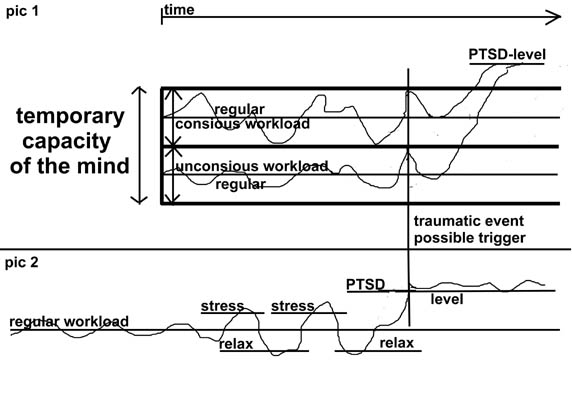
This workload is divided in the consious workload (we
can change) and the unconsious workload (wich can be changed or reduced
only by collateral affections.
You know, that fear, sorrow and of course hunger lets You still activate Your metabolism and mental work, to solve the problems causing this unconvenience (it´s naturally because it drives us to work for food and helps our body to survive).
This regulation process, that keeps us alive, has a bandwidth we all know (between lazyness and fear) and a short time high-stress level doesn´t affect us too much, as it reduces after we realize it and rest to relax.
Regularly the mental workload slows down at sleep and then builds up potential for the power next day.
THIS DOESN`T WORK AT ALL WITH PTSD-SYNDROM!!
In PTSD-Cases the mental workload reaches a level that is not temporary in the high-stress area.
Depending on too high unconsious workload after traumatic
experiences, the consious workload has not enough available capacity in
mind and the "motor" will get overheated, temporarly short time after the
traumatizing experience, also when such experiences are restimulated by
similar situations or similarities.
Regularly the mind can deal with this things for short
times, in PTSD-Cases the workload was too much for a person over Years
and/or the unconsious workload wasn´t reduced and grew up to a big
task, that is
taking more capacity from the mind then available for
it, reducing capacity for the consious workload.
Exhaustion will appear in times one can not rest and
upspeeded metabolism will appear in times one want to rest and the more
time someone spend with this symptoms without help the harder it is to
deal with.
The result is a chronic stress disorder, that appears
in situations of mental efforts, under problematically social circumstances,
while extreme mental activities and inconvenient long therm situations
for example.
Chronic appearance leads to a "traumatic personality"
as it is mostly seen on child-abused persons in their later life and second
world war veterans as far as vietnam veterans with reduced social security
service.
See also "Diagnostic categories of post traumatic stress disorder" in DSM IV (Int. Diagnostic manual).
PTSD-syndrom causes a wide area of psychologic and psychiatric symptoms, is not easily accessible through diagnostic standard tests and solutions today are rarely published and focus on actual research.
10 Years experience on this area showed us, that a solution depends on different circumstances like social contacts, general health and personality, self-conception, and also personal and financial prosperity, as far as it is important to learn about neurological correlations.
We suggest all types of body work, that helps regaining
fitness and opens blocked energie leads, also mental practice like meditation
and other similar treatments for deep relaxing can be proper for this.
Depending on the affects on the personality, Bach-Flowers
can do important effects here, because traumatic experiences mostly
give a lot of grieve, sadness and feeling of guilt about situations.
In long term PTSD-cases, major depression has found,
that can be treated with St.Johns wort, teas of thyme, cloves and anise,
garlic and clove extract, also aroma therapie is an outstanding solution
to disconnect suffering people from heavy thoughts (orange, anise, lemon
grass and cinnamon oil).
A combination of this treatments are tested and gave enormous help on actual suffering and also helped in chronic cases as it is possible to help on neurological changes, that are found in long term PTSD.
In special PTSD-clinics a combination of body and mental work is the most common solution for chronique PTSD syndrom, to change life and behavior is the only way to get rid of the symptoms.
Have a look at the NEWLIFE-EXPO, where You can find a lot of helpful treatments and meet experienced doctors and holistic healers, that can provide You more than solutions on this area!
If You want a personal exploration or more information, please mail to: newlifeexpo@web.de